Soft vs Hard Landscaping: Cost, Upkeep and What to Pick
 Robert EishoAugust 11, 2026
 Robert EishoAugust 11, 2026
If you have asked a landscaper for a quote, you have probably heard the words softscape and hardscape used as though everyone already knows what they mean. The distinction matters more than it first appears. It changes what your project costs, what order the work happens in, how much maintenance you inherit, and in New South Wales it even affects whether your plans get through council. This guide explains the difference, gives you the full list of what falls into each category, and covers the ratio question that trips up a lot of Sydney homeowners.
Quick answer: Soft landscaping is the living part of a garden, including lawn, trees, shrubs, garden beds, ground covers, soil and mulch. Hard landscaping is the built part, including paving, paths, decking, retaining walls, driveways, fences, pergolas and drainage. Hard landscaping is installed first and provides the structure; soft landscaping goes in last and softens it. Most gardens need both, and NSW councils set a minimum landscaped area that paving does not count towards.
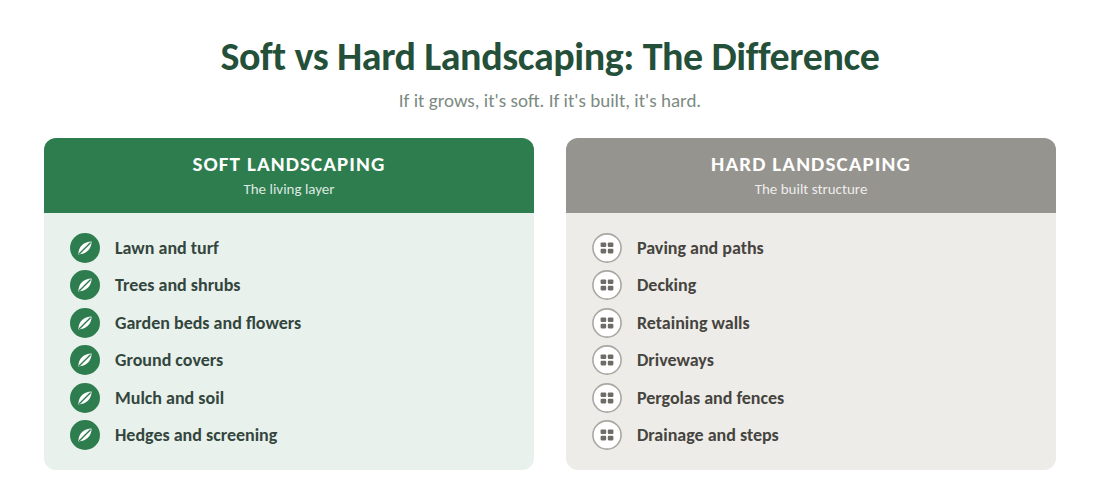
Soft landscaping is everything alive and growing, plus the soil and mulch that keeps it alive. Hard landscaping is everything built from non-living materials such as stone, concrete, brick and timber.
One useful way to think about it: hard landscaping is the architecture of a garden and soft landscaping is the furnishing. The hard elements decide where people walk, where water goes and how the space is divided. The soft elements bring colour, shade, scent and seasonal change. A garden built entirely from hard landscaping works fine, if a little stark. A garden with only soft landscaping rarely works at all, because plants still need paths to walk on, edges to hold them in and drainage to keep them healthy.
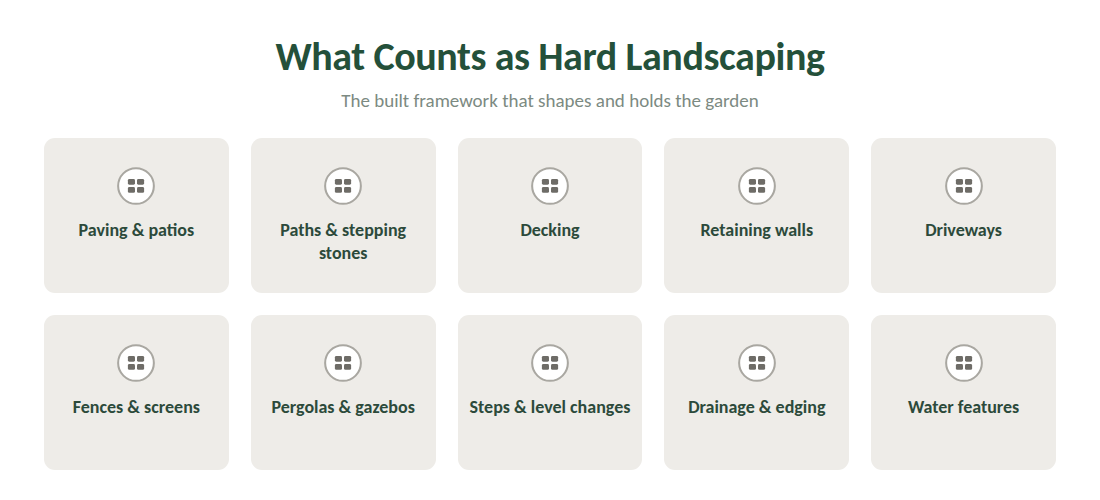
Hard landscaping covers any built element in the garden. It is the more technical side of the trade, since most of these items involve excavation, base preparation, and sometimes engineering or council approval.
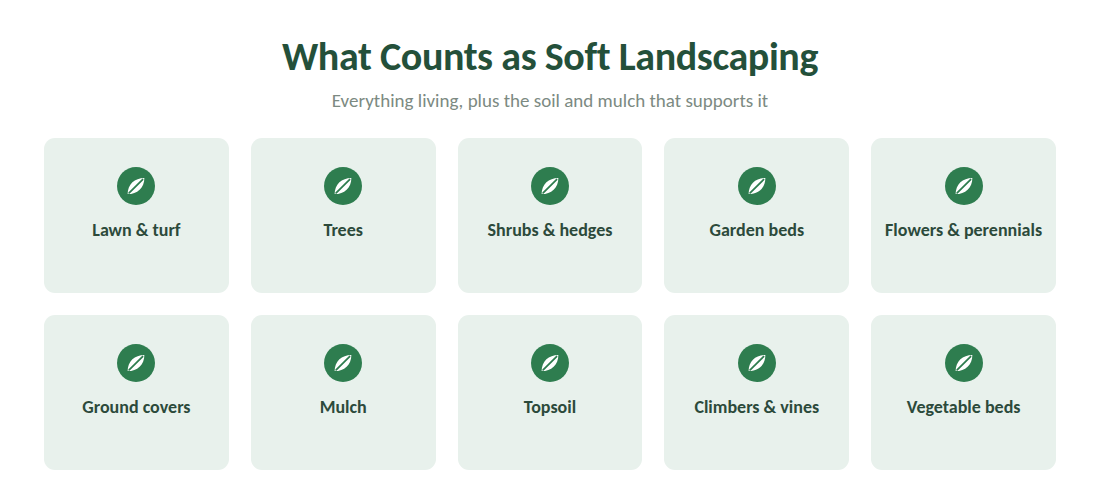
Soft landscaping is the living layer, and it includes the growing medium underneath. It is usually cheaper to install than hard landscaping but takes time to mature and needs ongoing care.
For Sydney conditions, hardy natives such as lomandra, westringia, grevillea and lilly pilly do most of the work with little water once established, a point the NSW Government makes in its water-saving guidance.
The two behave very differently over the life of a garden, which is worth understanding before you decide where the budget goes.
| Factor | Hard landscaping | Soft landscaping |
|---|---|---|
| Upfront cost | Higher; excavation, base, materials and skilled labour | Lower; mostly plants, soil and mulch |
| Lifespan | Decades when built properly | Continuous; plants grow, age and are replaced |
| Maintenance | Low; occasional cleaning and repointing | Ongoing; mowing, pruning, weeding, watering |
| Looks its best | Immediately on completion | After one to three seasons of growth |
| Drainage effect | Sheds water; can increase runoff | Absorbs water; helps it soak into the ground |
| Approval | Often needed for walls, decks and driveways | Rarely needed for planting alone |
| Flexibility | Difficult and costly to change later | Easy to adjust, move or replace |
Hard landscaping is always built first, and the sequence within it matters just as much. Levels and drainage come before anything else, then retaining and structural work, then paving, paths and decking. Soil preparation and irrigation follow, and planting and mulch go in last.
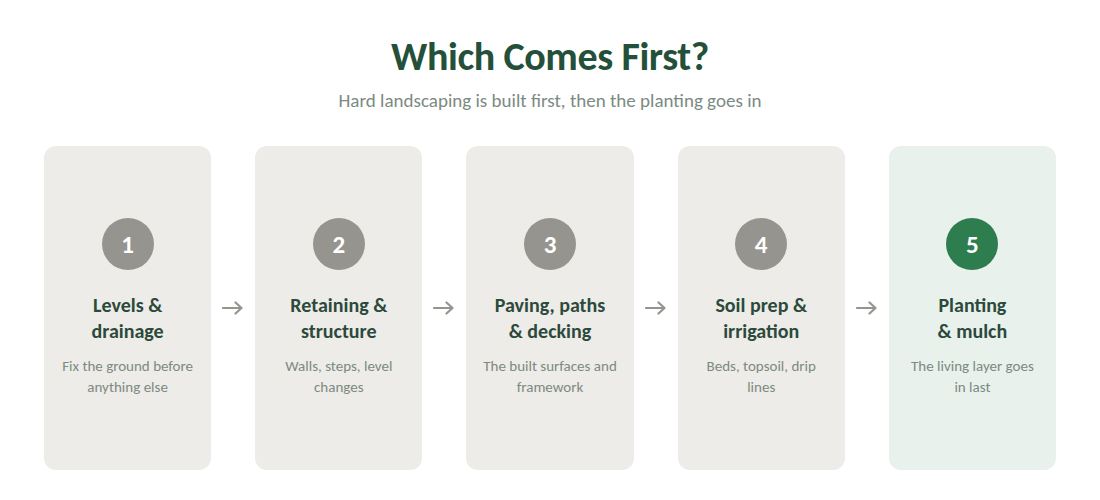
There is a practical reason for this. Excavators, barrows and construction traffic will destroy new planting, and no one wants to pay twice for the same plants. More importantly, drainage problems are far cheaper to fix before there is a paved surface or an established garden bed sitting on top of them. On Sydney’s reactive clay soils, that single decision is often the difference between a garden that lasts and one that fails within a few seasons.
Here is the part most guides on this topic miss entirely. In New South Wales, the balance between hard and soft landscaping is not purely an aesthetic decision. It is a planning requirement.
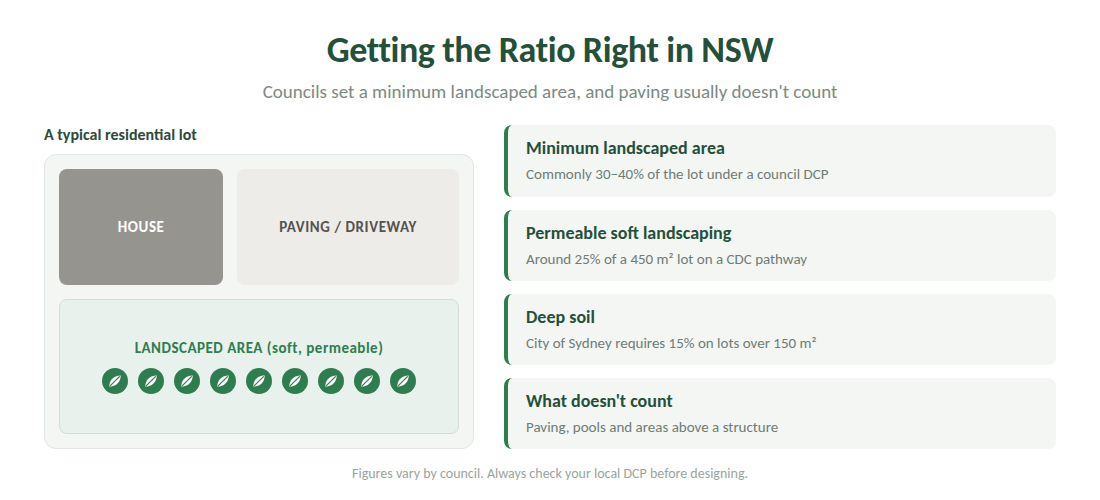
Councils set a minimum landscaped area in their Development Control Plan, commonly in the range of 30 to 40 per cent of the lot, and the definition usually excludes paved areas, pools and anything above a structure. On a complying development pathway, a minimum percentage of the site must be permeable soft landscaping, often around 25 per cent for a 450 square metre lot. The City of Sydney Landscape Code goes further again, requiring deep soil of at least 15 per cent of site area on lots larger than 150 square metres.
The reasoning is stormwater. Every square metre of impermeable paving is a square metre that sheds water into the street instead of soaking into the ground, and councils are increasingly firm about it. Permeable paving, gravel, mulch paths and decomposed granite can often count toward the landscaped area where solid concrete cannot, though definitions vary between councils. If your project involves a development application, check the local DCP on the NSW Planning Portal before the design is finalised rather than after.
Worth knowing: This catches people out on knock-down rebuilds and large paved entertaining areas. A design that looks reasonable can fail the landscaped area calculation, and the fix usually means removing paving late in the process, which is expensive. Resolve it at design stage.
Once the council minimum is met, the balance is a design decision driven by how you actually use the space. As a starting point, many Australian gardens sit near 60 per cent soft to 40 per cent hard. Families wanting lawn push further toward soft; households focused on entertaining, or working with a small courtyard, tip toward hard.
Whichever way you lean, the two work best when they are planned together rather than in sequence. Planting softens the edges of paving and makes a built area feel settled. Hard elements give planting a frame, hold soil in place and keep foot traffic where you want it. The Australian Government’s Your Home guide also recommends minimising unnecessary hard surfaces, which helps with runoff, heat and shade at the same time.
Small courtyards and terrace yards need a different approach, because hard surfaces dominate quickly and can make a compact space feel smaller.
Most landscaping problems trace back to the hard and soft elements being planned separately. Levels, drainage, retaining, paving and planting all interact, and the decisions made in the first week of a project determine what the garden costs to run for the next decade. Living Green Outdoors designs and builds outdoor spaces across Sydney and surrounding suburbs, resolving the structure and the planting as one plan, with council requirements factored in from the start. If you are weighing up a project, we can put together a design and a realistic scope for your block.
Soft landscaping is everything living in a garden, along with the soil and mulch that supports it: lawn, trees, shrubs, garden beds, ground covers and hedges. Hard landscaping is everything built from non-living materials: paving, paths, decking, retaining walls, driveways, fences, pergolas, steps and drainage. The simplest test is that soft landscaping grows and changes with the seasons, while hard landscaping stays as built. Hard landscaping forms the structure of a garden, and soft landscaping fills and softens it.
Hard landscaping covers any built or non-living element in a garden. That includes paving and patios, paths and stepping stones, decking, retaining walls, driveways, fences and privacy screens, pergolas and gazebos, steps and level changes, garden edging, drainage, and water features. These items usually need excavation, base preparation and sometimes engineering or council approval, so they are the more technical and more expensive part of most projects.
A lawn is the most common example. Others include trees, shrubs and hedges, garden beds, flowers and perennials, ground covers, climbers, vegetable beds, and the topsoil and mulch that support them. Soft landscaping is usually the cheaper part of a project to install, but it needs ongoing maintenance such as mowing, pruning, weeding and watering, and it takes time to mature into the look shown on a plan.
The two types are hard landscaping (also called hardscaping or hardscape) and soft landscaping (also called softscaping or softscape). Almost every garden project involves both. Hardscape provides structure, access and drainage, while softscape provides greenery, shade and seasonal change. A garden can be built entirely from hardscape, but a softscape-only garden is rarely practical because plants still need paths, edging and drainage to work properly.
In design terms, landscapes are commonly grouped into four broad types: natural landscapes shaped by the environment itself, residential landscapes around homes, commercial landscapes at business and public sites, and urban or civic landscapes such as parks, plazas and streetscapes. This is separate from the hard and soft distinction, which describes the materials used rather than the setting.
Hard landscaping goes in first, and the order matters. Levels and drainage are sorted first, then retaining and structural work, then paving, paths and decking. Soil preparation and irrigation follow, and planting and mulch go in last. Building this way avoids machinery, excavation and construction traffic damaging new planting, and it means drainage problems are fixed before anything is planted over them.
As a design guide, many Australian gardens work well at roughly 60 per cent soft to 40 per cent hard, though entertaining-focused or very small courtyards often carry more hard surface. More importantly, the ratio is not just a style choice in NSW. Councils set a minimum landscaped area in their Development Control Plan, commonly around 30 to 40 per cent of the lot, and paved areas are generally excluded from that calculation. Check your local DCP before finalising a design.
Hard landscaping usually costs far more upfront because it involves excavation, base preparation, materials and skilled labour, and elements like retaining walls and paving are priced per square or lineal metre. Soft landscaping is cheaper to install but carries ongoing costs for mowing, pruning, mulching and water. Over the life of a garden the gap narrows, since good hard landscaping can last decades with little attention while planting needs continuous care.
A well-designed backyard is one of the best rooms...
Robert EishoJuly 19, 2026Backyard Landscaping Ideas: 15 Ways to Transform Your Sydney Backyard
A well-designed backyard is one of the best rooms in the house, it’s just outside. Done right, it becomes a place to eat, relax, entertain and...
Robert EishoJuly 19, 2026The grounds of a commercial property do a lot of...
Robert EishoAugust 23, 2026Commercial Landscaping Ideas: Design, Upkeep and Safety
The grounds of a commercial property do a lot of quiet work. They shape the first impression a client forms before they reach reception, they affect...
Robert EishoAugust 23, 2026
