New Home Landscaping Ideas Sydney: Estate Garden Guide
 Robert EishoOctober 17, 2026
 Robert EishoOctober 17, 2026
A new build in Marsden Park, Oran Park, Box Hill, Austral or Leppington hands over the same way almost every time. The house is finished, the driveway is poured to the garage, and everything either side of it is bare compacted clay with a few lengths of conduit poking out. Somewhere in the contract there is a design guideline telling you how long you have to fix that, and what the result has to look like from the street.
This guide covers both halves of the job. What the estate requires of you, and what actually works on a compact Sydney block once the requirement is met.
Quick answer: Landscaping a new estate home runs in a set order. Read your estate’s design guidelines first, because most Sydney release estates set a completion deadline and specify minimum tree sizes, soft landscaping proportions, fence height and driveway finish. Then fix soil and levels, since the lot arrives compacted, stripped of topsoil and often draining back towards the slab. Build the front yard in layers of canopy tree, clipped mid-storey and strap plants behind a hard edge. Zone the rear yard into entertaining, service, turf and deep soil rather than leaving it as one open strip. Budget around $6,000 to $16,000 for a front yard finished to guideline, plus $3,000 to $9,000 for soil and drainage first.
Nearly every guide to new home landscaping opens with design ideas. On a new estate lot that is the wrong starting point, because the ground you are planting into has just had a house built on it and trucks driven over it for eight months.
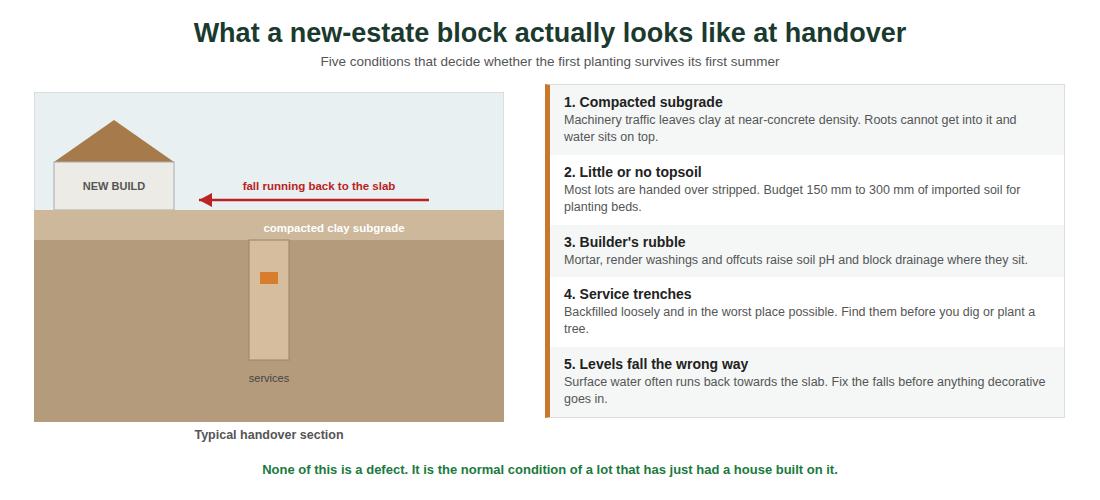
Compaction is the big one. Machinery traffic leaves clay at a density roots cannot penetrate and water cannot drain through. Plant straight into it and the hole behaves like a bucket. The fix is not complicated but it is physical work. Rip or turn the subgrade where beds and turf will go, break up any rubble, then bring in a decent soil profile over the top. Allow 150 mm to 300 mm of imported soil for planting beds and at least 100 mm under turf.
Levels are the second one. On a lot of new builds the surface falls back towards the slab, because the pad was built up and the surrounds were never graded away from it. Fixing that after paving and planting costs several times what it costs beforehand.
Do this first: Mark your service runs before anything else. Water, sewer, gas, electrical and NBN conduits were backfilled loosely and rarely sit where you would expect. A free Before You Dig Australia enquiry, lodged online or on 1100, gives you the plans, and Sydney Water’s Tap in service covers the sewer and water assets. Both are free and both take minutes.
This is the part most articles on Sydney landscaping skip entirely, and it is the part that will cost you money if you get it wrong. Nearly every land release estate in Sydney registers a design covenant or a developer deed against the lot, and the landscaping sits inside it alongside the house design.
The requirements are more specific than people expect. Here is what three published NSW estate guidelines actually ask for.
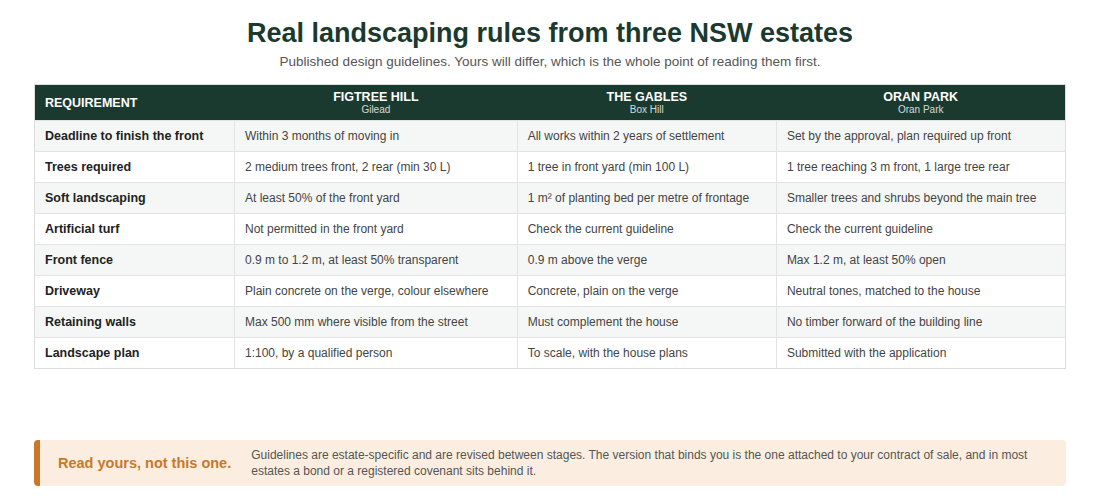
The version that binds you is the one attached to your contract of sale, not the PDF currently on the estate website. Guidelines are revised between stages, and a lot sold in stage 4 may sit under a different document to one sold in stage 12. If you cannot find yours, ask the developer’s sales office for the version referenced in your contract.
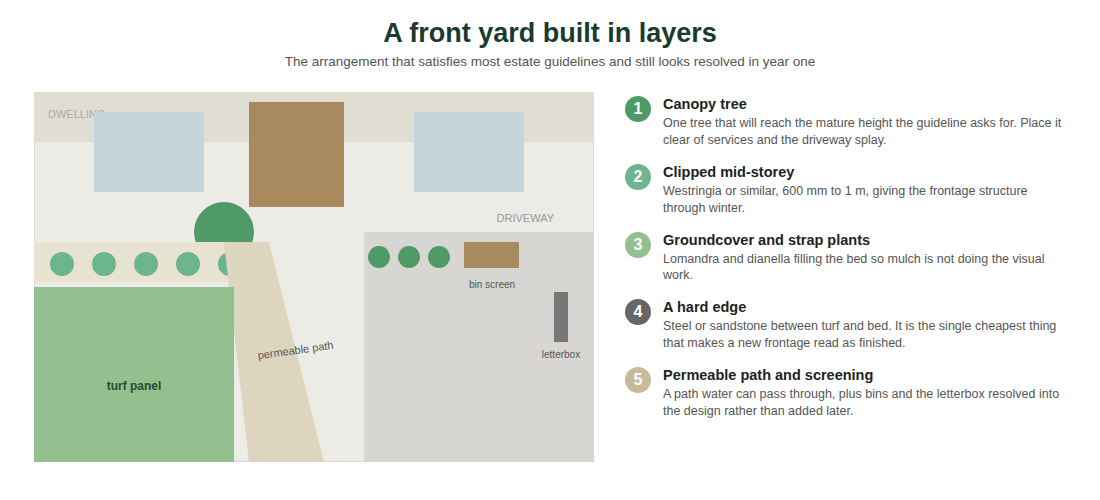
Once you know the rules, the front yard becomes a fairly solvable problem. The arrangement below meets most guidelines and, more usefully, looks resolved in its first year rather than in its fifth.
For a wider set of frontage treatments beyond the estate context, see our front yard landscaping ideas.
New estate lots are small and the house takes most of them. A 350 m² lot with a four-bedroom house on it often leaves 60 m² to 120 m² at the rear. The instinct is to leave it as one open space so it feels bigger. In practice the opposite is true. An undivided rectangle reads as leftover ground; a divided one reads as rooms.
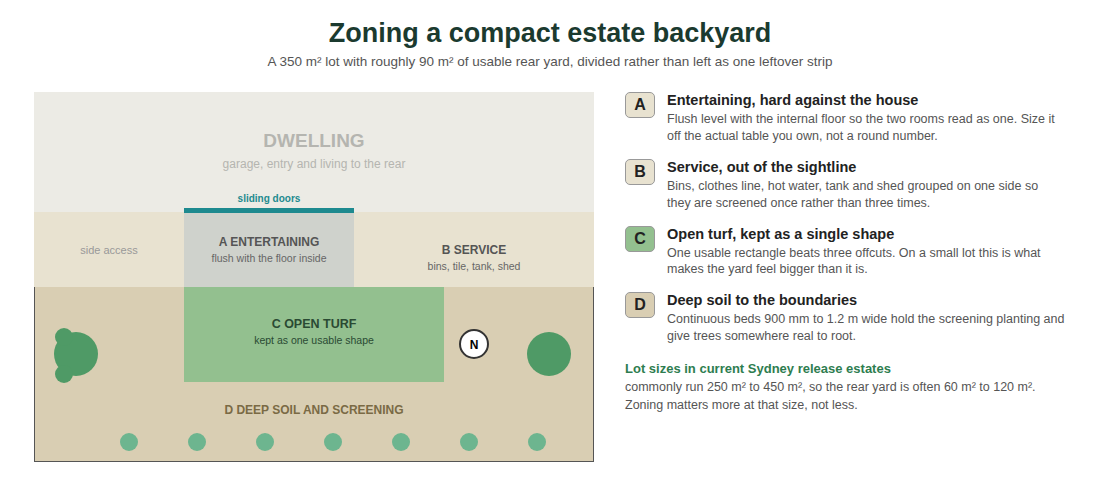
Set the paving or deck level with the internal floor so the two spaces read as one. This single move does more for a small yard than anything else, and it is far cheaper to get right while the surrounds are still bare. Size it off the outdoor setting you actually own, plus 800 mm of clear space on every side a chair pulls out into.
Bins, clothes line, hot water unit, rainwater tank, and the air conditioning condenser. Put them together on one side, usually the side with the gate, and screen the lot in one go. Most compact yards look cluttered because these items are scattered and each one has been screened separately, or not at all.
One rectangle you can actually do something on beats three awkward offcuts. If the remaining space is too small to be useful as turf, it is better as paving or planting than as a patch of grass nobody uses.
Raised beds in timber or block along a boundary, or a planted screen against a fence, give you greenery without consuming floor space. A 900 mm to 1.2 m continuous bed down each boundary also gives trees somewhere real to root, which matters when the rest of the lot is compacted.
The zoning question is worth more detail than it gets here. We have written it up separately in backyard zoning, and there is a broader set of treatments in our backyard landscaping ideas.
Sydney sits in Climate Zone 5, warm temperate, under the NSW planting guidance. On a new estate lot you are also dealing with heat reflected off new brickwork and Colorbond, thin soil and no established canopy. That is a harsher position than an established suburb two kilometres away.
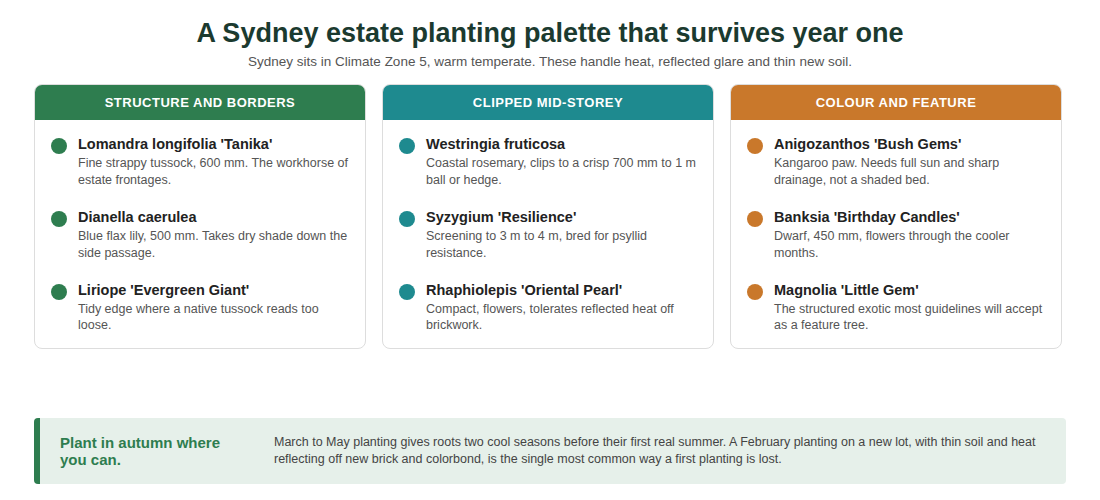
Mix natives with a few structured exotics rather than going all one way. A planting that is entirely native can read as loose and unfinished against a new render-and-brick facade, which is often what the estate panel is reacting to when they ask for changes. A clipped Westringia hedge and a ‘Little Gem’ magnolia alongside kangaroo paw and dwarf banksia gives you the structure the architecture wants and the water performance the climate wants.
Timing matters more than species. Autumn planting, March to May, gives roots two cool seasons to establish before their first real summer. A February planting on a bare estate lot is the most common way a first planting is lost, and it is usually blamed on the plants rather than the date.
This comes up constantly in searches, and the honest answer is that the number varies by who is teaching it. The list below is the version most commonly taught. What matters is less the count than what each one does on a block this size.
| Principle | What it means on a compact estate lot |
|---|---|
| Unity | Everything reads as one scheme. Repeat two or three materials and a short plant list rather than using one of everything. |
| Balance | Visual weight distributed sensibly. On a narrow frontage, asymmetric balance usually works better than a mirrored layout. |
| Proportion and scale | Match plant mature size to the space. The most common error on estate lots is a tree that will outgrow the setback within a decade. |
| Rhythm and repetition | Repeating a plant or a material at intervals. This is what makes a small space feel considered rather than busy. |
| Focalisation | One thing the eye lands on. On a small lot you get one, not three. A specimen tree, a water feature or the entry. |
| Simplicity | Fewer elements, done properly. Small spaces punish variety harder than large ones. |
| Line | The edges that lead the eye. Bed edges, paving joints and the path. Straight lines suit the architecture of most new builds. |
If you would rather see how these get applied in sequence on a real site, our landscape design process walks through it from concept to completion.
This is one of the most searched questions on the topic and most of the answers online quote an overseas figure. The Australian picture is better documented than it used to be.
The Plant Value Report 2025, produced by Greener Spaces Better Places with Domain using listing data from September 2024 to August 2025, found homes marketed with established greenery sold for a premium of 17.4 per cent nationally, and 28.7 per cent in Sydney. Listings also attracted around 7 per cent more views.
Read that carefully. It measures homes marketed with greenery against those that are not. It is a correlation across listings, not a controlled test of what a given dollar of landscaping returns. Treat it as evidence that presentation matters, not as a promise of return on a specific project.
We go into this in more depth in does landscaping add value to your home.
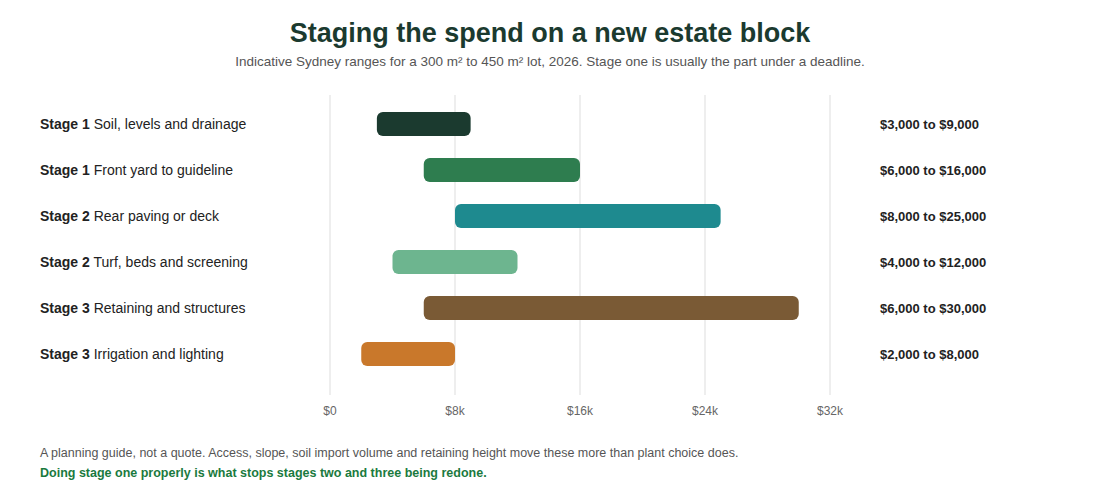
You do not have to do everything in the first year, and on most budgets you should not. What you do have to do is the part under a deadline and the part that would have to be torn up later.
| Stage | Indicative range | What it covers |
|---|---|---|
| Stage 1 Soil, levels, drainage | $3,000 to $9,000 | Ripping compaction, removing rubble, imported soil, grading away from the slab, ag line where needed |
| Stage 1 Front to guideline | $6,000 to $16,000 | Trees, mass planting, turf and verge, edging, path, letterbox and bin screening |
| Stage 2 Rear paving or deck | $8,000 to $25,000 | Flush-level entertaining area, steps, drainage connection |
| Stage 2 Turf, beds, screening | $4,000 to $12,000 | Rear turf, boundary beds, screening planting, fencing make-good |
| Stage 3 Retaining and structures | $6,000 to $30,000 | Retaining walls, pergola or patio, raised beds, engineering where required |
| Stage 3 Irrigation and lighting | $2,000 to $8,000 | Dripline, controller and sensor, low-voltage lighting, tank connection |
Site access is the single biggest variable in Sydney. A lot with 900 mm side access and no rear gate means every cubic metre of soil, every paver and every bag of waste is barrowed through, and that can add thousands before any material is bought. For a fuller picture across project types, see our Sydney landscaping cost guide.
The design guideline is a private agreement with the developer. Separately, planning law still applies.
Your council’s local environmental plan and development control plan set minimum landscaped area and deep soil requirements, and these are tighter on small lots than most people realise. If you are looking at a dual occupancy or a manor house under the Low Rise Housing Diversity Code, the complying development standards require landscaped area of 50 per cent of the parent lot area minus 100 m², with at least 25 per cent of it forward of the building line and at least half of the required area behind it. The same code calls for a tree reaching 5 m at the front and 8 m at the rear, and sets principal private open space at a minimum of 16 m² with a minimum dimension of 3 m.
Pergolas, patios, decks and verandahs are capped at 25 m² under the Codes SEPP exempt development provisions, while gazebos and cabanas sit under a separate 20 m² limit. Both are capped at 3 m high with a 900 mm boundary setback, and a combined cap applies across all decks, patios, pergolas and verandahs of 15 per cent of the dwelling’s ground floor area on lots over 300 m².
Once planted, a tree on your lot may be protected by your council’s tree preservation controls. That cuts both ways. It is a reason to place trees carefully now, and a reason not to assume you can remove one later because it turned out to be in the wrong place.
Living Green Outdoors works across South West Sydney’s release corridor, including Austral, Leppington and Denham Court, with the full list on our service areas page. If you have just taken handover and want the stage one work scoped before the clock runs down, get in touch and we will walk the block with you and read the guideline alongside you.
For the full scope of what we build, see our landscaping services.
Work in layers. One canopy tree sized to your setback, a clipped mid-storey such as Westringia at 700 mm to 1 m, and strap plants like Lomandra ‘Tanika’ and Dianella filling the beds at proper density. Add a steel or sandstone edge between turf and beds, a permeable path, and screening that resolves bins and the letterbox into the design. On a new estate lot, check your design guideline first, because minimum tree sizes, fence height and the proportion of soft landscaping are usually specified.
On compact Sydney lots the strongest current ideas are flush-level indoor to outdoor transitions, zoned yards rather than one open rectangle, raised and vertical planting to save floor space, grouped and screened service areas, permeable surfaces, and sub-surface drip irrigation on a controller. Low-input gathering areas such as a compact fire pit on gravel are popular because they work year round without ongoing upkeep.
The list most commonly taught is unity, balance, proportion and scale, rhythm and repetition, focalisation, simplicity, and line. Different courses teach five, six or seven, so the exact count varies. On a small estate lot the ones that do the most work are proportion, because the usual error is a tree too large for the setback, and simplicity, because a small space punishes variety harder than a large one does.
Australian listing data from the Plant Value Report 2025 found homes marketed with established greenery sold at a 17.4 per cent premium nationally and 28.7 per cent in Sydney, with around 7 per cent more listing views. That is a correlation across listings rather than a controlled test. On a new estate lot the usual order of return is the front yard first, then a weatherproof outdoor living area connected to the house, then fencing and screening, then established structural planting.
It depends on the estate and on the version of the guideline attached to your contract. Figtree Hill at Gilead requires the front to be landscaped, including turf to the verge, within three months of moving in. Stockland’s The Gables at Box Hill allows two years from settlement for all works. Some estates hold a bond or a registered covenant against completion. Check the document referenced in your contract of sale rather than the one currently published on the estate website.
In most Sydney release estates, yes. Design guidelines commonly require a scaled landscape plan, often at 1:100 and often prepared by a qualified designer, horticulturist or landscaper, submitted with your house plans to the estate’s design review panel. That is separate from any council approval, which may also be needed for structures, retaining walls over a certain height, or works on a constrained site.
Often not. Several Sydney estate guidelines prohibit artificial turf in the front yard or anywhere visible from the street, and some set a minimum proportion of real turf and planting beds instead. Rear yards are usually less restricted. Check the guideline before ordering, because it is an expensive thing to install twice.
Three things, in order. Lodge a free Before You Dig Australia enquiry so you know where the services run. Fix the levels so surface water drains away from the slab rather than back towards it. Then rip the compacted subgrade and bring in soil where beds and turf are going. Everything decorative sits on top of those three, and none of them is cheap to retrofit.
The grounds of a commercial property do a lot of...
Robert EishoAugust 23, 2026Commercial Landscaping Ideas: Design, Upkeep and Safety
The grounds of a commercial property do a lot of quiet work. They shape the first impression a client forms before they reach reception, they affect...
Robert EishoAugust 23, 2026Most articles on this question quote the same...
Robert EishoAugust 18, 2026Does Landscaping Add Value? Australian Costs and Returns
Most articles on this question quote the same figure: landscaping adds up to 28 per cent to your home’s value. Chase that number back and it...
Robert EishoAugust 18, 2026