Pebble and Gravel Landscaping Ideas for Australian Homes
 Robert EishoOctober 20, 2026
 Robert EishoOctober 20, 2026
Stone is the cheapest way to cover ground that nothing wants to grow on, and the most commonly botched. Most of the advice you will find online is written for American or British conditions, in inches, using product names no Australian supplier stocks. The result is people ordering the wrong size, laying the wrong thing underneath, and spending a weekend fixing it two years later.
This guide is written for Sydney and Australian conditions. What the stone is actually called here, how much you need, what goes underneath, and the one planning rule that catches people out.
Quick answer:
Pick stone by behaviour, not looks. Angular stone such as deco granite locks together when compacted and suits paths. Rounded river pebble rolls and migrates, so it suits planting beds where nobody walks. Lay it at 40 mm to 50 mm for beds and 50 mm to 75 mm over a compacted base for paths. Skip weed mat in planting beds, because debris collects on top of it and weeds root through within a few years; use non-woven geotextile only under paths and driveways, where it is a structural separation layer. One 20 kg bag covers about 0.25 m² at 50 mm, so budget roughly four bags per square metre, and order bulk by the tonne for anything over about 5 m².
Start here, because the terminology gap is the reason so much of this goes wrong. Overseas guides talk about pea gravel and quarter-inch crushed stone. Walk into a Sydney landscape yard and ask for either and you will get a blank look. Here everything is graded in millimetres and sold by common name.
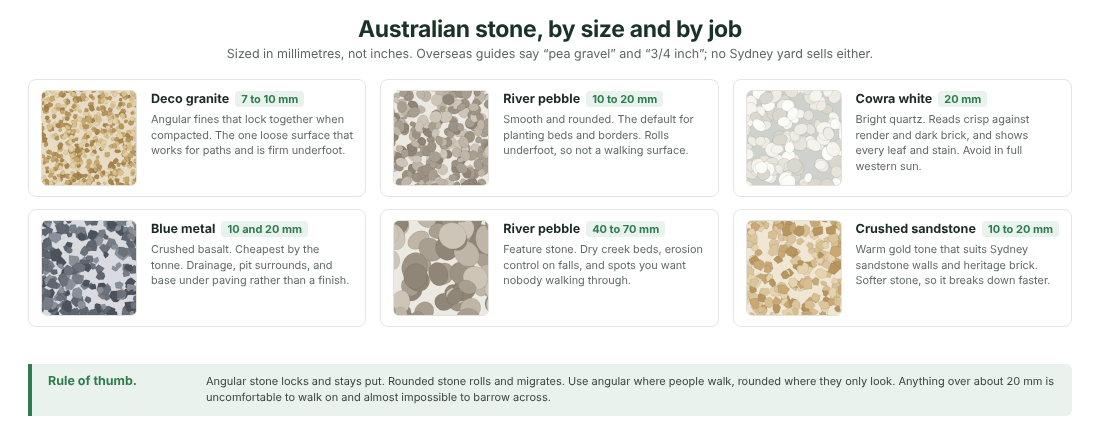
Two properties decide almost everything about how stone behaves. The first is size. The second is whether it is angular or rounded.
Angular stone, such as deco granite or crushed sandstone, has broken faces that key into each other. Compact it and it stays put, which is why it is the only loose material that makes a decent path. Rounded stone, such as river pebble, has no faces to lock. It rolls underfoot, migrates downhill and spreads out of beds onto paving. That makes it excellent as a visual surface and poor as a walking one.
The size that catches people out: anything above about 20 mm is uncomfortable to walk on barefoot, awkward in thongs, and close to impossible to push a barrow or pram across. Keep the big stone for places people only look at.
This is the question people actually search, and most pages dodge it. The arithmetic is simple once you have the density. Pebble and gravel run at roughly 1.5 tonnes per cubic metre, so a 20 kg bag is about 0.013 cubic metres of material.
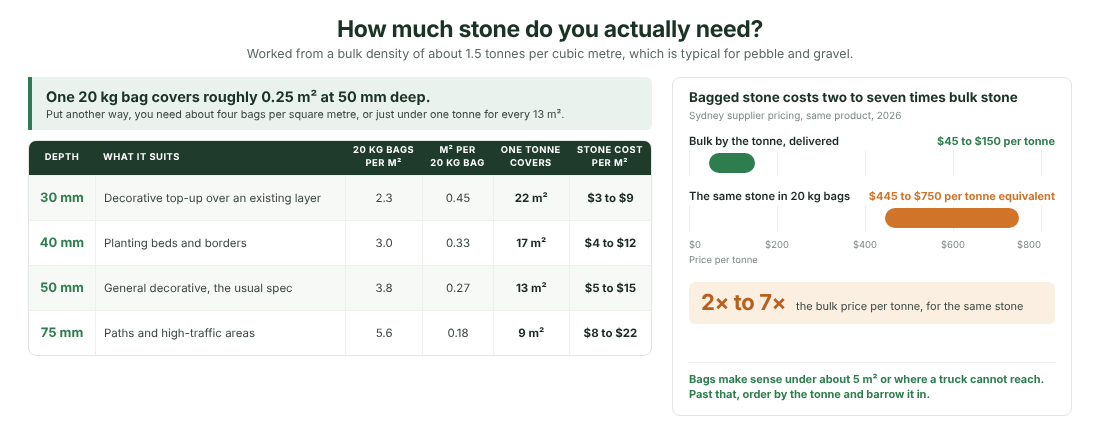
Sydney yards sell the same stone two ways and the gap is stark. Bulk delivered stone runs roughly $45 to $150 per tonne depending on the product. The identical stone in 20 kg bags works out between $445 and $750 per tonne once you do the sum. On a 20 m² bed that is the difference between about $150 and about $1,100.
Bags still make sense for small areas, for topping up, or where a truck genuinely cannot reach. Past about five square metres, order a bulk bag or a tipper load and barrow it in.
Check access before you order. A tipper needs clear space to tip and a reasonably level spot. If the only option is a verge drop, you are responsible for clearing it promptly and for any damage to the nature strip. On tight blocks a one-tonne bulk bag craned or hand-barrowed is often the sensible compromise.
Every overseas guide gives the same instruction. Lay heavy-duty weed fabric, then spread your stone. It sounds sensible. In a planting bed it is close to the worst thing you can do.
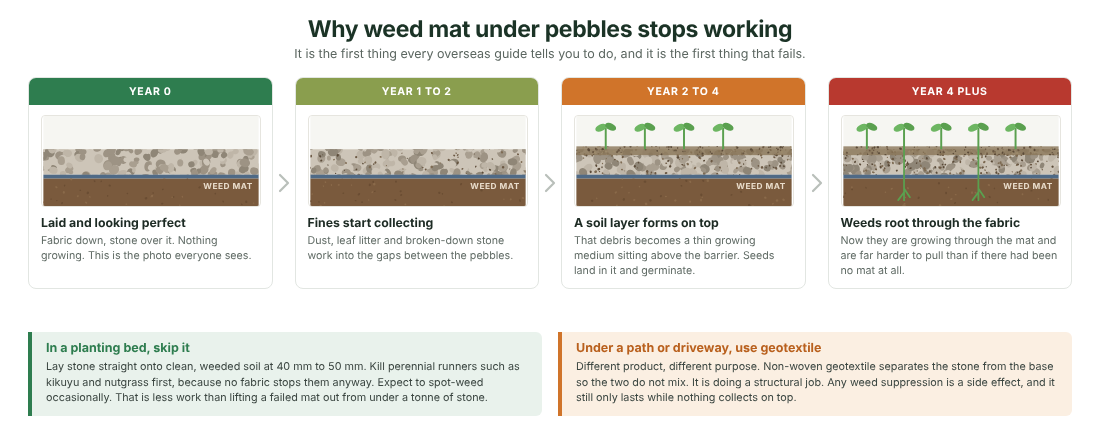
The fabric does stop weeds coming up from below, and for a year or two it works. Then physics takes over. Dust, leaf litter, broken-down stone and general grime wash into the gaps between the pebbles and settle on top of the fabric. Within a few years that debris has become a thin layer of soil sitting above the barrier. Seeds land in it, germinate in it, and root down through the weave.
At that point you are worse off than if you had laid nothing. The weeds are anchored into the fabric rather than into loose soil, so they tear rather than pull. The mat has also been blocking water and air exchange and starving soil biology the whole time, and it makes planting anything new a matter of cutting holes in a shredding sheet under a tonne of stone.
Perennial runners defeat it anyway. Kikuyu, couch and nutgrass all travel sideways and come up at the edges or straight through.
Under a path, courtyard or driveway, a non-woven geotextile is doing something completely different. It separates the stone from the compacted base so the two do not grind into each other and so the stone does not punch down into the subgrade. That is a structural job. Any weed suppression is incidental.
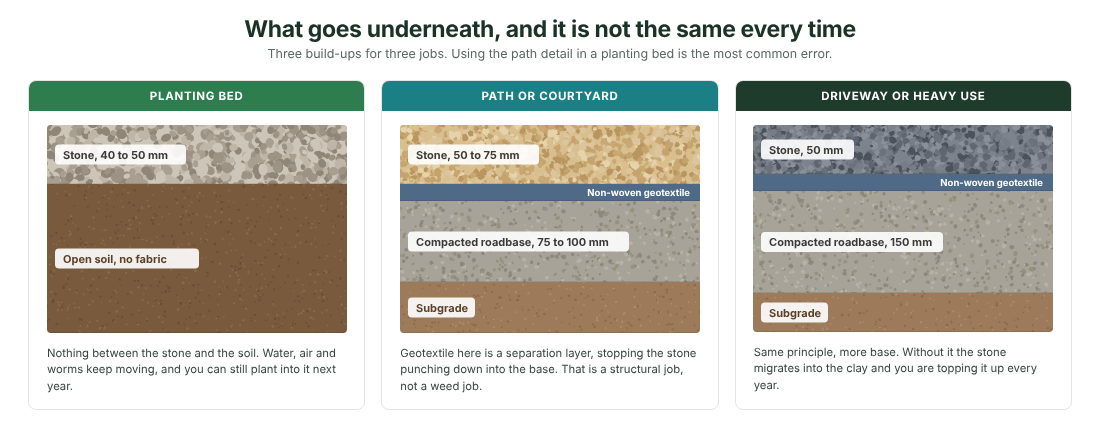
The build-up for a trafficked surface matters more than the stone on top of it. Without a compacted roadbase layer the stone works its way into the clay, you lose depth every year, and the surface turns to a rutted mess after rain. Getting the base and the falls right is proper excavation and groundwork, not something to improvise.
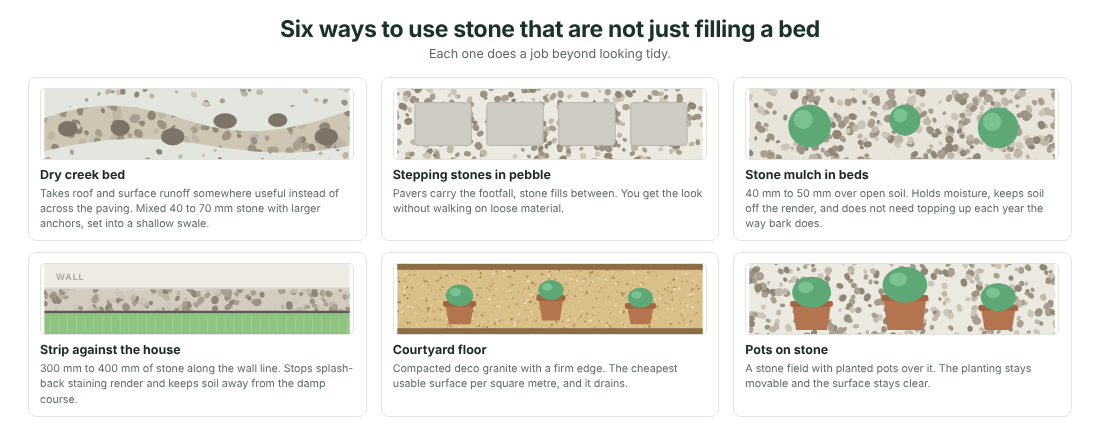
The best of them, because it earns its place. A shallow swale lined with mixed 40 mm to 70 mm stone, with larger anchor stones set into the line, takes roof and surface runoff somewhere useful instead of letting it sheet across the paving. On Sydney’s clay blocks, where water tends to pond, this solves a drainage problem and reads as a feature at the same time. Set it on a genuine fall and finish it into a pit or a planted soak, not into the neighbour’s fence line.
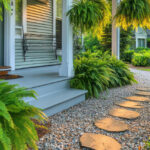
Large format pavers carrying the footfall, with stone filling between them. You get the look of a stone field without the problem of walking on loose material. Space the pavers at a natural stride, around 600 mm centre to centre, and set them flush so nobody catches a toe.
40 mm to 50 mm over open soil. It holds moisture, keeps soil off render and fences, and does not need replacing every year the way bark does. The trade-off is that it adds no organic matter to the soil, so beds under stone need feeding rather than relying on mulch breaking down. Use it around established structural planting rather than around things you will be lifting and dividing.
300 mm to 400 mm of stone against the wall line. It stops rain splashing soil up onto render, keeps bed soil away from the damp proof course, and gives you a clean line to run along. Unglamorous, and one of the few stone details that pays for itself in reduced wall cleaning.
Deco granite or crushed sandstone, compacted, with a firm edge. Per square metre it is the cheapest usable outdoor surface you can build, it drains, and it suits an informal or heritage setting. It is not as firm as paving, so consider who is using it. Prams, wheelchairs and walking frames all struggle on loose surfaces, and even compacted fines are harder going than a paved area. We compare the broader options in soft versus hard landscaping and in our guide to patio paving ideas.
A clean stone surface with planted pots arranged on it. The planting stays movable, the surface stays clear, and you can change the whole look by moving three pots. It suits small courtyards and rental properties, and it works well where soil depth is limited over a slab.
Stone also sits naturally with water. A pebble surround to a pond or a bowl is the standard detail, covered in our guide to water feature ideas.
This is the part no other article on the subject mentions, and it is the one with real consequences. People gravel an entire front yard to cut down the work, then discover they have breached a council control.
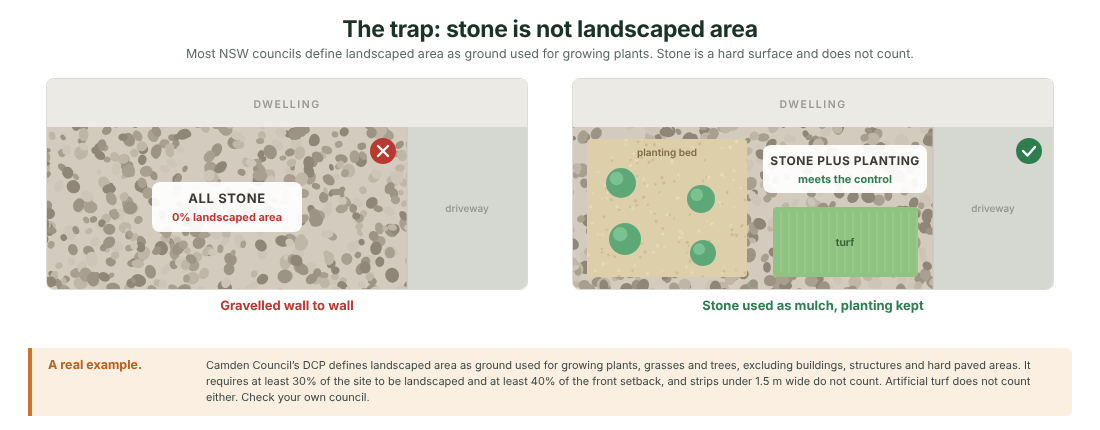
Most NSW councils use the standard definition. Camden Council’s development control plan puts it plainly. Landscaped area means a part of a site used for growing plants, grasses and trees, and it does not include any building, structure or hard paved area. Stone is a hard surface. It does not count.
Camden then requires a minimum of 30 per cent of the site to be landscaped, at least 40 per cent of the front setback to be landscaped, and excludes any strip narrower than 1.5 metres from the calculation. Artificial turf does not count either. Other Sydney councils use similar numbers with local variations.
How to use stone without falling foul of it: treat stone as mulch within planting beds rather than as a replacement for them. A bed of stone with structural planting through it still reads as planting on a site plan and still performs. A wall-to-wall stone yard does not.
There is a separate point about permeability. Stone laid loose on open soil does let water through. Stone laid over a fabric and a compacted base largely does not, and some councils count that as an impervious surface for stormwater purposes. If permeability is the goal, our guide to permeable paving covers the systems that are designed for it.
Stone is low input rather than no input. Three things keep it tidy.
| Item | Indicative range | Notes |
|---|---|---|
| Blue metal, 10 or 20 mm | $40 to $100 per tonne | Cheapest common stone. Drainage and base work rather than a finish |
| Nepean river pebble | $45 to $150 per tonne | The standard decorative pebble across Sydney, in 10, 20 and 40 mm |
| Cowra white, 20 mm | $100 to $330 per tonne | Premium white quartz. Price varies most with order volume |
| Deco granite or toppings | $60 to $180 per tonne | Compactable fines for paths and courtyards |
| Stone in 20 kg bags | $9 to $25 per bag | Equivalent to $445 to $750 per tonne. Small areas only |
| Supply and lay, decorative bed | $35 to $70 per m² | Weed removal, edging, stone and spreading |
| Supply and lay, compacted path | $80 to $160 per m² | Excavation, roadbase, geotextile, edging and stone |
Labour is the larger share on anything that needs a base. A decorative bed is mostly material cost; a compacted path is mostly excavation and base. Access drives both. For a wider view of outdoor project pricing, see our Sydney landscaping cost guide.
Stone work is simple to describe and physical to execute. A 20 m² bed is a tonne and a half of material moved by barrow, and a compacted path means excavation, base, compaction and edging before any stone is spread.
Living Green Outdoors builds stone beds, dry creek beds, compacted paths and courtyards across Sydney as part of broader landscaping projects. If you are weighing stone against turf or paving for a particular area, get in touch and we will look at the aspect, the falls and the use before recommending one.
For more ideas on where stone fits in a wider scheme, see our backyard landscaping ideas, front yard landscaping ideas and our guide to backyard zoning.
It depends on what the area is for. In a planting bed, lay the stone straight onto clean, weeded, graded soil with no fabric, because weed mat under pebbles fails within a few years once debris collects on top of it and weeds root through. Under a path, courtyard or driveway, use a non-woven geotextile over a compacted roadbase. There the fabric is a separation layer stopping the stone punching into the base, which is a structural job rather than a weed control one. In both cases, remove perennial runners such as kikuyu and nutgrass first and install a hard edge.
The most useful applications are a dry creek bed that takes surface runoff, stepping stones set into a pebble field so you are not walking on loose stone, pebble used as mulch in planting beds at 40 mm to 50 mm, a 300 mm to 400 mm strip along the house to stop splash-back onto render, a compacted deco granite courtyard floor, and a stone field with planted pots arranged over it. Pebble also makes the standard surround for a pond or water bowl.
About 0.25 square metres at 50 mm deep, which is the usual decorative depth. At 40 mm it covers around 0.33 square metres and at 30 mm around 0.45 square metres. Put the other way around, you need roughly four 20 kg bags per square metre at 50 mm. The calculation assumes a bulk density of about 1.5 tonnes per cubic metre, which is typical for pebble and gravel. For anything over about five square metres, bulk stone by the tonne is two to seven times cheaper than the same product in bags.
Yes, and in planting beds that is the better option. Lay them at 40 mm to 50 mm over clean, weeded, graded soil. Water, air and soil life keep moving, and you can still plant into the bed later. The two things to do first are removing perennial weeds, which no barrier stops anyway, and installing a hard edge so the stone does not migrate. On a trafficked surface it is different. There the stone needs a compacted roadbase underneath or it will work its way into the soil and you will lose depth every year.
40 mm to 50 mm for decorative beds and borders, which is deep enough to hide the soil and suppress most germination. 30 mm is enough for a top-up over an existing layer. 50 mm to 75 mm for paths and areas that take foot traffic, over a compacted base. Going much deeper than 50 mm over the root zone of established plants is not recommended, because it starts restricting gas exchange to the roots.
Usually not. Most NSW councils define landscaped area as part of a site used for growing plants, grasses and trees, excluding buildings, structures and hard paved areas. Stone is a hard surface, so it does not count. Camden Council, for example, requires at least 30 per cent of the site and at least 40 per cent of the front setback to be landscaped, and excludes strips narrower than 1.5 metres. Artificial turf does not count either. Use stone as mulch within planting beds rather than as a replacement for them, and check your own council’s controls before covering a large area.
As a material, yes. Supply and lay for a decorative stone bed in Sydney typically runs $35 to $70 per square metre, against roughly $80 to $160 for a compacted stone path and considerably more for paving. Turf is cheaper again to install but carries ongoing water and upkeep costs that stone does not. The honest comparison depends on use. Stone is cheapest where nobody walks, and the gap closes quickly once a proper base is needed.
In Australian usage, pebbles are smooth and rounded, usually river-sourced, and sold in sizes like 10, 20 and 40 mm. Gravel generally means crushed angular stone such as blue metal or deco granite. The practical difference is behaviour rather than appearance. Angular gravel locks together when compacted and stays where you put it, so it suits paths and bases. Rounded pebble rolls and migrates, so it suits beds and decorative areas where nobody is walking.
The grounds of a commercial property do a lot of...
Robert EishoAugust 23, 2026Commercial Landscaping Ideas: Design, Upkeep and Safety
The grounds of a commercial property do a lot of quiet work. They shape the first impression a client forms before they reach reception, they affect...
Robert EishoAugust 23, 2026Landscaping in Sydney costs roughly $50 to $150 per...
Robert EishoJune 10, 2026How Much Does Landscaping Cost in Sydney? (2026 Price Guide)
Landscaping in Sydney costs roughly $50 to $150 per square metre for basic work, and $200 to $550+ per m² once paving, retaining walls and structures...
Robert EishoJune 10, 2026