How Much Does Paving Cost in Sydney?
 Robert EishoNovember 27, 2026
 Robert EishoNovember 27, 2026
Published paving prices run from $60 to $300 a square metre, which makes them close to useless on their own. The spread is not the trade being vague. It is three different things being measured and called the same thing, and once you can tell them apart you can work out roughly where your own job lands before anyone walks the site.
This guide sets out Sydney rates by material, shows what sits inside a quote, prices a 30 square metre driveway line by line, and covers the two approvals that catch people out.
Quick answer
Paving in Sydney costs roughly $65 to $300 per square metre supplied and laid, depending on the material. Concrete pavers sit at $65 to $150, clay at $95 to $180, porcelain at $120 to $260 and natural stone at $130 to $300. Those rates usually cover the paver and the labour only. Excavation and base preparation are a separate line, around $25 to $55 per square metre for a walked-on area and far more for a driveway, which needs a reinforced concrete base rather than roadbase. A paved driveway also needs a Section 138 approval and a council-built vehicle crossing, typically $280 to $850 in fees plus $1,800 to $5,500 to construct.
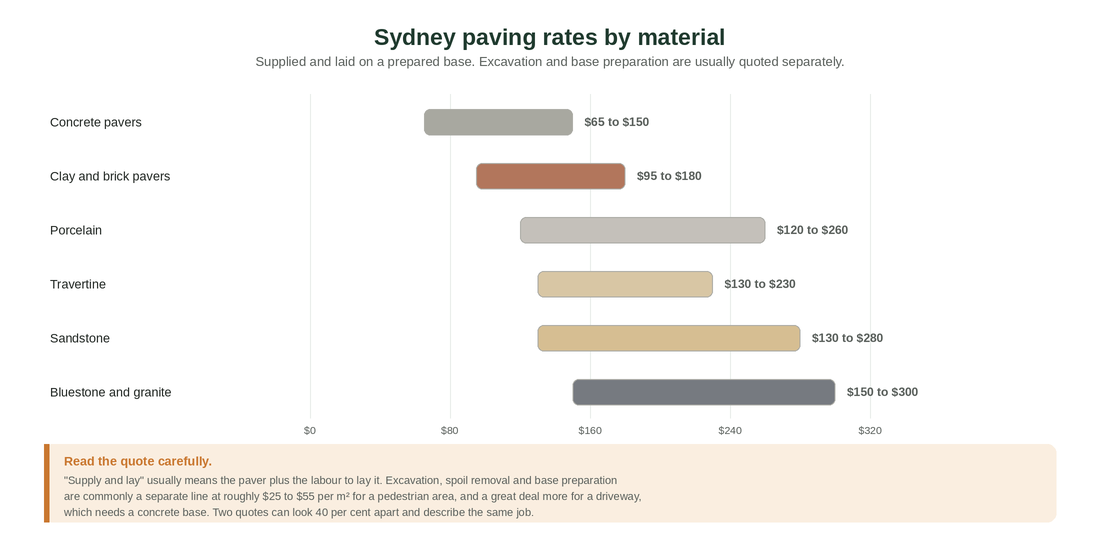
| Material | Per m² supplied and laid | What you are paying for |
|---|---|---|
| Concrete pavers | $65 to $150 | The value option. Modern ranges imitate stone convincingly and come driveway rated |
| Clay and brick pavers | $95 to $180 | Colour runs through the body, so chips do not show. Traditional look, very durable |
| Porcelain | $120 to $260 | Low porosity, stain resistant, consistent sizing. Needs careful cutting and the right adhesive on a slab |
| Travertine | $130 to $230 | Cool underfoot, the usual pick for pool surrounds. Porous, so it wants sealing |
| Sandstone | $130 to $280 | The Sydney stone. Weathers well and suits heritage and brick homes |
| Bluestone and granite | $150 to $300 | Hardest wearing and most formal. Heaviest to handle, which shows in the labour |
Before you compare two quotes, check whether each one includes excavation, spoil removal and base preparation. Many paving rates cover the paver and the laying only, with site preparation priced separately at roughly $25 to $55 per square metre for a pedestrian area. Two numbers can look wildly different and describe exactly the same job.
Here is a 40 square metre patio in concrete pavers on a roadbase and sand bed, broken into its parts.
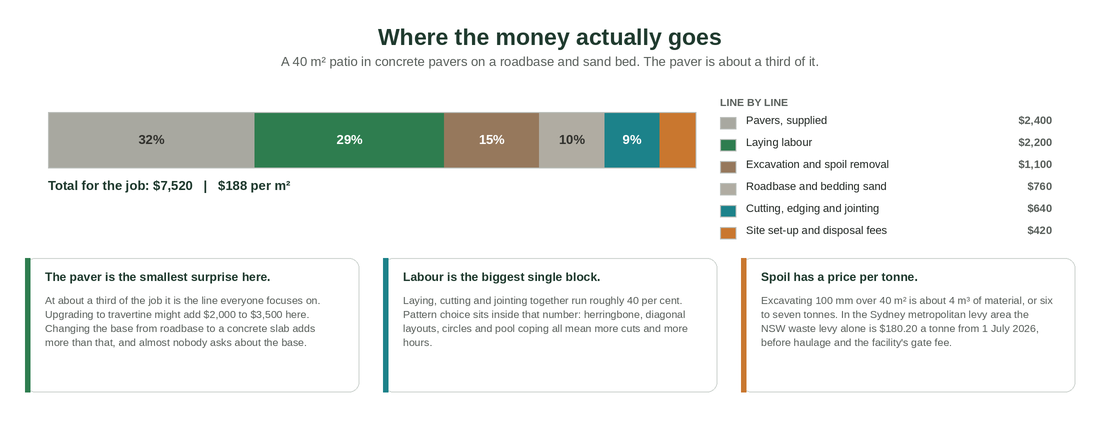
At roughly a third of the job, the paver is the line everyone focuses on and the one with the least leverage. Upgrading a 40 square metre patio from a mid-range concrete paver to travertine might add $2,000 to $3,500. Changing the base from compacted roadbase to a reinforced concrete slab adds more than that, and almost nobody asks about the base.
Laying, cutting and jointing together run around 40 per cent. Pattern sits inside that number. A straight stack bond is quick. Herringbone, diagonal layouts, circles, curved edges and pool coping all mean more cuts, more waste and more hours. If you are weighing up a pattern, that is where it costs you, not in the pavers. There are more layout ideas in our guides to patio paving and block paving trends.
Excavating 100 mm across 40 square metres produces about 4 cubic metres of material, which is six to seven tonnes. In the Sydney metropolitan levy area the NSW waste levy alone is $180.20 per tonne from 1 July 2026, up from $174.20 the year before, and that is before haulage and the facility’s gate fee. Clean natural soil and rock can often go to a recycler more cheaply than mixed spoil to landfill, which is one reason a contractor who separates material can quote lower. This is excavation work in its own right, not an afterthought.
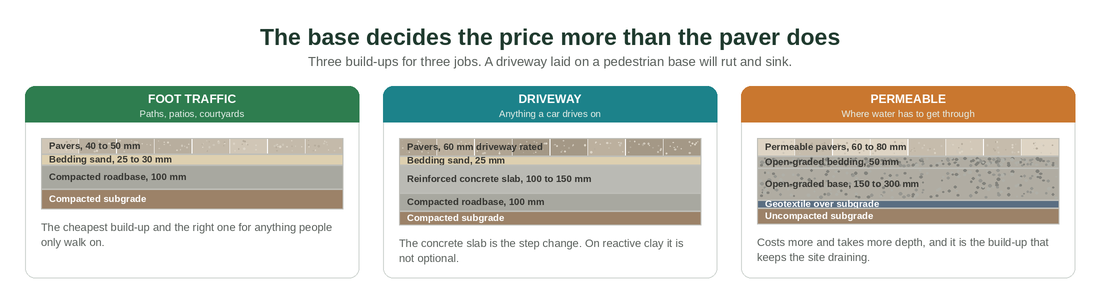
This is the question worth asking first. A cheap paver on a correct base outlasts an expensive paver on a thin one, every time. If a driveway quote does not mention a concrete base, the quote is not for a driveway.
This comes up constantly and the usual answer, a per-square-metre rate, is badly misleading. Here is the same job priced properly.
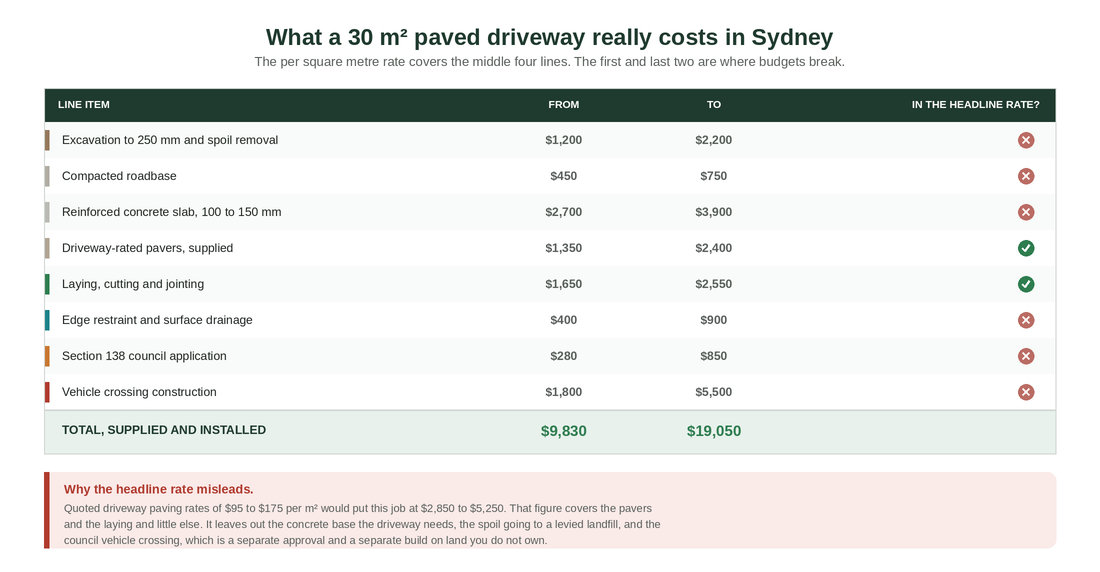
Quoted driveway paving rates of $95 to $175 per square metre would put this job at $2,850 to $5,250. The realistic all-in figure is $9,830 to $19,050. The gap is the concrete base the driveway needs, the spoil going to a levied landfill, and the council vehicle crossing, which is a separate approval and a separate build on land you do not own.
Our broader Sydney landscaping cost guide sets out how other outdoor projects are priced on the same basis.
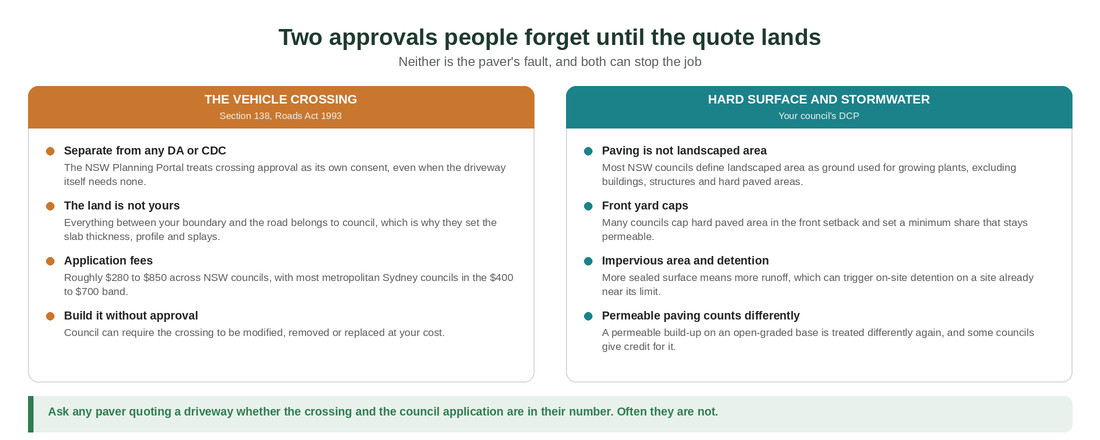
Everything between your boundary and the road belongs to council. The crossing over it, sometimes called the layback or crossover, needs its own approval under Section 138, and the NSW Planning Portal treats that as separate from a development application or a complying development certificate. The private driveway on your side may need no planning approval at all while the crossing still does.
Application fees run roughly $280 to $850 across NSW councils, with most metropolitan Sydney councils in the $400 to $700 band. Some councils require the crossing itself to be built by a contractor from their approved list, and public liability cover of $20 million is commonly required for work in the road reserve. If a contractor pours a crossing without approval, council can require it to be modified, removed or replaced at your cost.
Most NSW councils define landscaped area as ground used for growing plants, grasses and trees, excluding buildings, structures and hard paved areas. Paving does not count towards it. Many councils also cap hard paved area in the front setback and set a minimum share of the frontage that has to stay permeable.
There is a stormwater consequence too. More sealed surface means more runoff, which can push a site over its impervious area allowance or trigger on-site detention. A permeable build-up is treated differently again, and some councils give credit for it. If you are paving a large area, settle this before the base goes in rather than after.
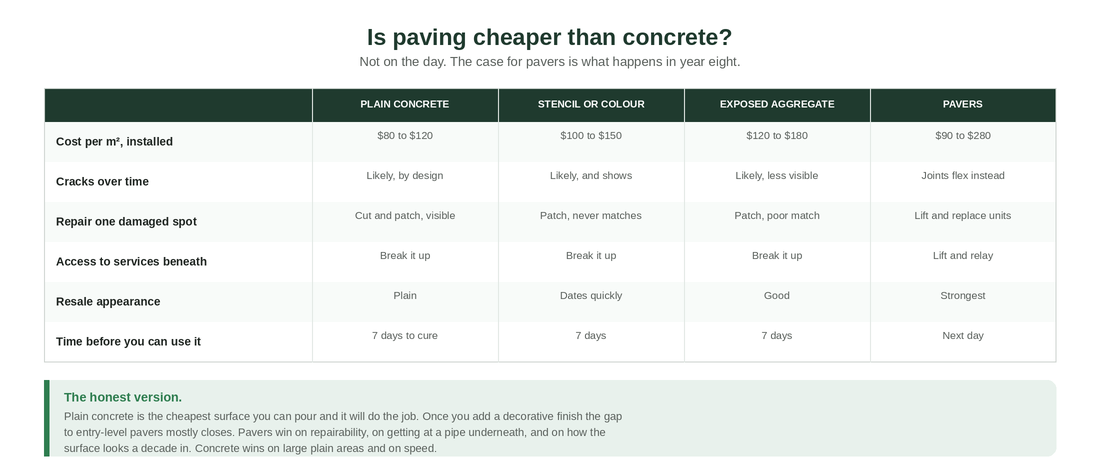
Plain concrete is the cheapest surface you can pour and it will do the job. Once you add a decorative finish, though, the gap to entry-level pavers mostly closes. Stencil and colour run $100 to $150 a square metre, exposed aggregate $120 to $180, and concrete pavers start at $65.
Where pavers earn the difference is afterwards. Concrete is designed to crack at control joints and does not always oblige. A cracked slab is cut and patched, and the patch never matches. A damaged paver is lifted and replaced with one from the spares, and nobody can tell. The same applies when a pipe or a cable under the surface needs attention. Pavers lift and relay. Concrete gets broken up.
Concrete wins on large plain areas, on speed and on a flat budget. Pavers win on repairability, on access to what is underneath, and on how the surface looks a decade in. Both sit on the hard side of a scheme, and the balance between them is covered in soft versus hard landscaping. If you already have a concrete driveway, our guide on looking after a concrete driveway is the companion piece.
Paving is a long-life surface rather than a no-effort one. Sealing is worth it on porous stone such as sandstone and travertine, and generally unnecessary on porcelain. Joints need topping up with the right sand every few years, especially where water runs across the surface. Efflorescence, the white bloom that appears on new concrete and clay pavers, usually weathers off on its own within a year and is not a defect. Our guide to getting a longer life out of outdoor paving goes through the rest.
A square metre rate is a starting point, not a quote. What decides your figure is the base the surface needs, what is under the ground now, how material gets to the work area, and whether a council crossing is involved.
Living Green Outdoors handles the whole sequence, from excavation and site preparation through concrete and base work to the finished paving, as part of broader landscaping projects across South West Sydney. You can see completed work on our portfolios page, and the suburbs we cover are listed on our service areas page.
If you want a figure for your own block rather than a range off the internet, get in touch and we will measure the area, check the access and the fall, and tell you what the base actually needs before quoting.
In Sydney, roughly $65 to $300 per square metre supplied and laid, depending on the material. Concrete pavers run $65 to $150, clay and brick $95 to $180, porcelain $120 to $260, travertine $130 to $230, sandstone $130 to $280 and bluestone or granite $150 to $300. Those rates generally cover the paver and the labour to lay it. Excavation, spoil removal and base preparation are usually a separate line at around $25 to $55 per square metre for a pedestrian area, and considerably more for a driveway, which needs a reinforced concrete base.
Budget $9,800 to $19,000 all in for a 30 square metre paved driveway in Sydney. That breaks down as roughly $1,200 to $2,200 for excavation and spoil removal, $450 to $750 for roadbase, $2,700 to $3,900 for the reinforced concrete slab, $1,350 to $2,400 for driveway-rated pavers, $1,650 to $2,550 for laying and cutting, $400 to $900 for edge restraint and drainage, $280 to $850 for the council Section 138 application, and $1,800 to $5,500 to build the vehicle crossing. A headline paving rate of $95 to $175 per square metre would suggest $2,850 to $5,250, which covers only the pavers and the laying.
Not on installation day. Plain concrete is the cheapest surface you can pour, typically $80 to $120 per square metre, against $65 to $300 for pavers depending on the material. Once you add a decorative concrete finish the gap narrows a long way, with stencil or colour at $100 to $150 and exposed aggregate at $120 to $180 against concrete pavers from $65. Over time pavers often work out better value, because a damaged unit is lifted and replaced invisibly while a cracked slab has to be cut and patched, and services underneath can be reached by lifting pavers rather than breaking concrete.
People usually mean concrete rather than cement, and the answer is the same. A plain concrete slab is cheaper to install than most paving. Where paving competes is on repairability, on access to pipes and cables beneath the surface, on appearance after several years, and on being usable the next day rather than after a seven day cure. For a large plain area on a tight budget, concrete is hard to beat. For a frontage, a patio or anything that will be looked at closely, pavers generally justify the difference.
Standard concrete pavers in a straight pattern on a compacted roadbase, at roughly $65 to $150 per square metre supplied and laid. For areas nobody walks on, decorative gravel or pebble is cheaper again. The cheapest option is not always the best value, though. A low rate on a thin base will cost more in the end than a slightly higher rate on a base built for the use, and on a driveway the base is not something to economise on.
For the crossing between your boundary and the road, yes. That land belongs to council and the crossing needs approval under Section 138 of the Roads Act 1993, which the NSW Planning Portal treats as separate from any development application or complying development certificate. Application fees run roughly $280 to $850 across NSW councils. The private driveway on your own land may need no planning approval, but hard paved area caps and stormwater controls in your council’s development control plan can still apply, particularly in the front setback.
Three reasons. First, scope: some quotes include excavation, spoil removal and base preparation while others cover only the paver and the laying. Second, the base: a roadbase and sand bed costs far less than a reinforced concrete slab, and only one of them is suitable under a driveway. Third, access and site conditions: a block where materials are barrowed through a narrow side passage takes substantially more labour than one a bobcat can reach. Ask every contractor to price the same written scope and the spread usually narrows a long way.
Sixty millimetres is the usual minimum for a residential driveway, against 40 mm to 50 mm for a patio or path. Thickness alone is not enough, though. A driveway paver needs a reinforced concrete slab of 100 mm to 150 mm beneath it on compacted roadbase, not the sand and roadbase build-up used for foot traffic. Laying a correctly rated paver on a pedestrian base is one of the more common ways a driveway fails within a few years.
As Australia continues to face rising temperatures,...
Robert EishoMay 20, 2025Why Aussie Homes Need Permeable Paving in 2025
As Australia continues to face rising temperatures, more frequent floods, and prolonged droughts, it’s clear that our homes and cities need to...
Robert EishoMay 20, 2025Your driveway, patio, or garden path is often the...
Robert EishoOctober 14, 2025Block Paving Trends for Beautiful Outdoor Spaces
Your driveway, patio, or garden path is often the first thing people see. Creating a beautiful outdoor space can completely transform the look and feel...
Robert EishoOctober 14, 2025