Types of Pavers: Concrete, Travertine, Sandstone and Porcelain
 Robert EishoNovember 27, 2026
 Robert EishoNovember 27, 2026
Four materials cover almost every residential paving job in Sydney. Most comparisons of them stop at colour, texture and price, which is the easy part and the part a showroom sample already answers.
The decisions that actually matter outdoors are how much water the material absorbs, what slip classification it carries, and how it has to be laid. Those three determine whether a surface stains, whether it is safe around a pool, and whether it cracks. This guide covers all four materials on those terms.
Quick answer: Concrete pavers are the value option at $65 to $150 per m² laid and the only one of the four that comes driveway rated off the shelf at 60 mm. Travertine stays cooler underfoot than most stone, which is why it dominates pool surrounds, but it is porous and needs sealing. Sandstone suits heritage and brick homes and weathers well, and it is the softest and most absorbent of the four. Porcelain at 20 mm absorbs 0.5 per cent or less, never needs sealing and usually carries a published slip rating, but it is brittle and has to be laid on a correct bed. For a pool surround, start with the slip classification, not the colour.
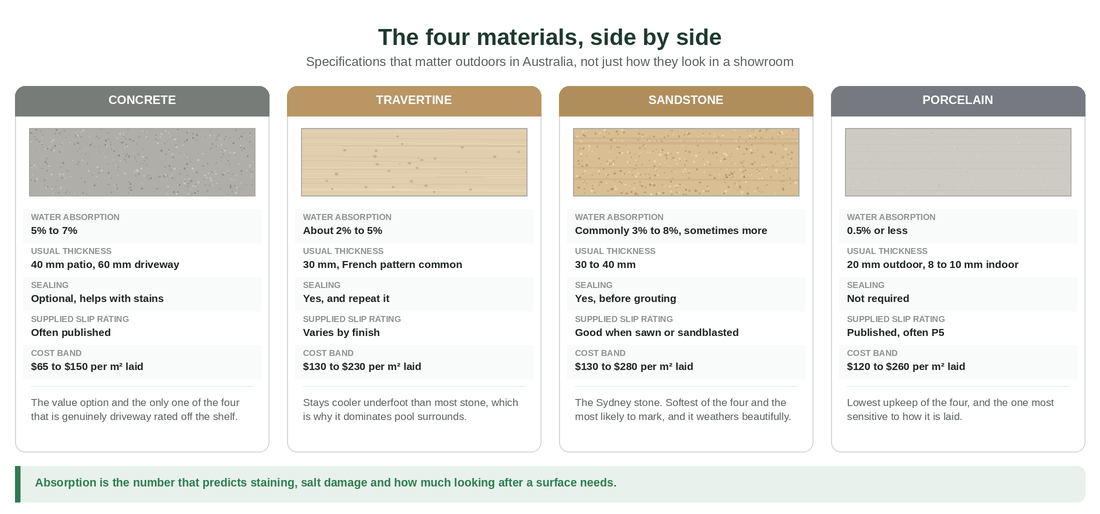
Manufactured from cement, aggregate and oxide, pressed and cured. They cover the widest range of shapes, sizes and finishes, including surfaces made to imitate stone convincingly. At 40 mm they suit patios and paths; at 60 mm they are rated for vehicles, which is why almost every paved driveway in Sydney is concrete.
The thing to ask about is whether the colour runs through the body or sits on the surface. Through-coloured pavers hold their appearance far better under Sydney UV, and when a corner chips the exposed body reads the same as the face rather than showing grey. Expect some efflorescence in the first year, a white bloom that weathers off and is not a defect.
A form of limestone laid down around mineral springs, which is where the characteristic pitting comes from. It is sold filled and honed, or unfilled and tumbled. The reason it dominates Australian pool surrounds is simple: it stays noticeably cooler underfoot than darker stone and most dark concrete in summer sun.
The trade-off is porosity. It absorbs spills, so it wants sealing before use and resealing periodically. It is also sensitive to acid, which means pool chemistry and the wrong cleaner can permanently dull the surface. Filled travertine also tends to lose some filler over the years, and the pits reappear.
Sydney was built from it, and it still reads as belonging here in a way imported stone does not. Sawn or sandblasted finishes give good grip, the colour range is warm and the material weathers into something better looking than it started as.
It is the softest of the four and the most absorbent, commonly 3 to 8 per cent and sometimes higher. In a shaded damp spot it stays wet and grows things. Near the coast or around a salt pool, salt crystallising inside the stone flakes the face off over time, which is called fretting. Seal it before grouting, because grout haze on unsealed sandstone is very hard to undo.
Clay pressed at high pressure and fired above 1,200 degrees until it vitrifies. A true porcelain absorbs 0.5 per cent of its weight in water or less, which is the industry definition and the number worth asking for, because the word gets used loosely in retail.
Outdoor porcelain is 20 mm thick, against 8 to 10 mm for the indoor tile of the same design. That extra thickness is what allows it to be laid on pedestals or in gravel rather than only bonded down. The practical advantages are that it never needs sealing, it does not fade, and reputable ranges publish a tested slip classification. The disadvantage is brittleness, which is entirely an installation question.
This is the single biggest gap in most paver comparisons, and it is the one with consequences.
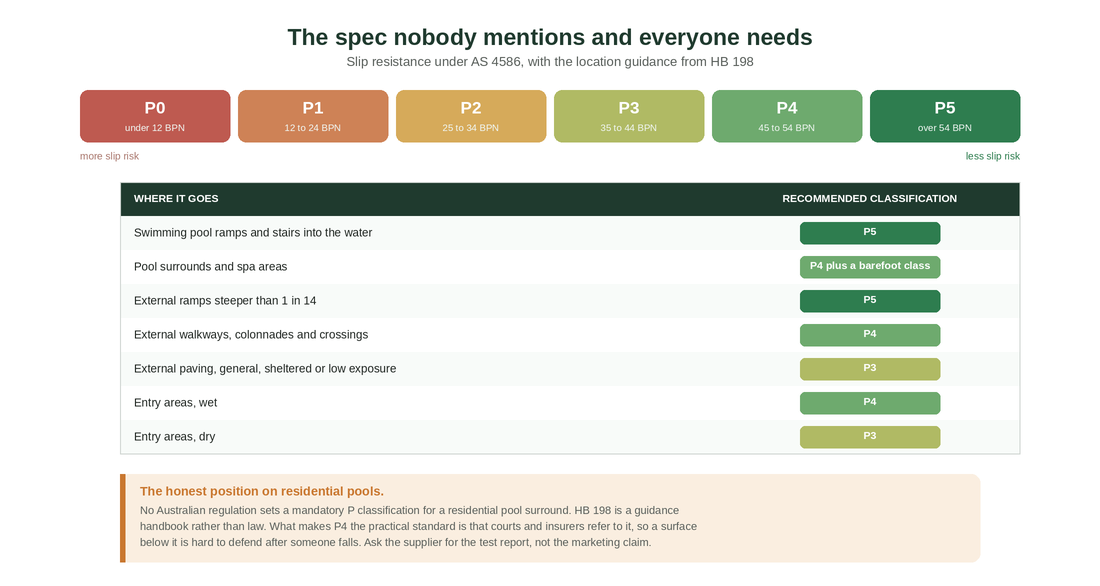
Australian Standard AS 4586 classifies the slip resistance of new pedestrian surfaces. The 2013 edition replaced the older V to Z classes with P0 to P5, based on a wet pendulum test. The companion handbook, HB 198, maps those classes to locations, and it is what most specifications adopt.
For paving the relevant entries are straightforward. Pool surrounds and spa areas call for P4 together with a barefoot class. Ramps and stairs leading into the water call for P5. External ramps steeper than 1 in 14 call for P5. General external paving sits at P3 to P4 depending on exposure.
The honest position on residential pools. No Australian regulation sets a mandatory classification for a residential pool surround, and HB 198 is a guidance handbook rather than law. What makes P4 the practical standard is that courts and insurers refer to it, so a surface below it is hard to defend after someone falls. Ask the supplier for the wet pendulum test report on the specific finish, not a marketing claim about the product family.
Finish matters more than material here. The same sandstone can be sawn, honed or sandblasted and test very differently. A honed porcelain made for indoor floors is a hazard outdoors, while an outdoor-rated version of the same design will carry P5. If you are working on a pool surround, this is the first decision, not the last.
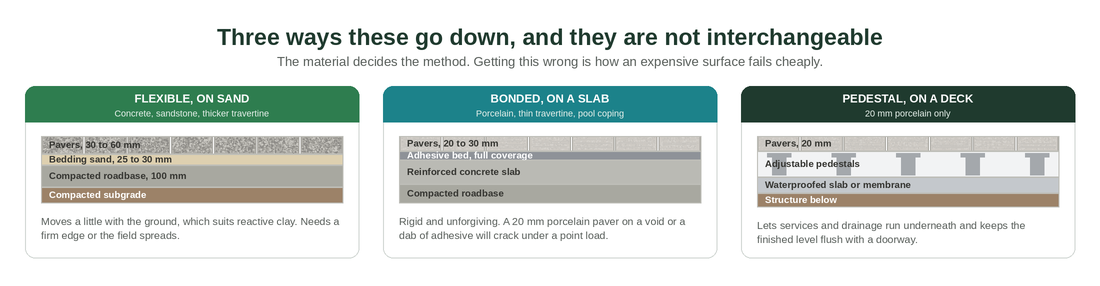
That slab requirement is the hidden cost in a porcelain quote. If the area does not already have one, you are paying for concrete work before you pay for pavers. Our concrete and decking and excavation pages cover that side of the job.
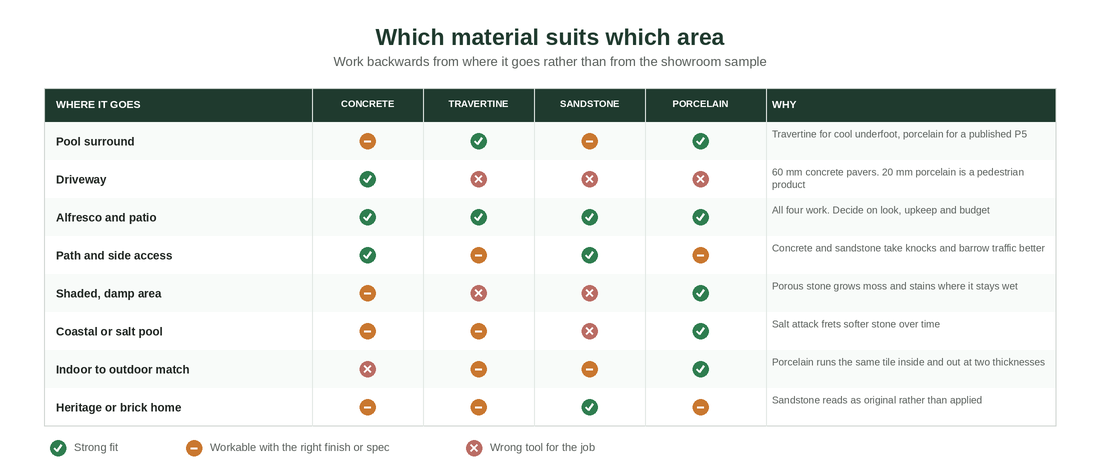
Travertine or porcelain. Travertine wins on comfort underfoot in summer and looks the part. Porcelain wins on a published slip classification, immunity to pool chemicals and salt, and never needing sealing. Sandstone can work with a sandblasted finish, but around a salt pool it is the one most likely to fret over time.
Concrete pavers at 60 mm, on a reinforced concrete base. This is not really a contest. 20 mm porcelain is a pedestrian product, and natural stone at driveway thickness gets expensive quickly. If you already have a concrete driveway and are weighing resurfacing against replacing, our guide to looking after a concrete driveway covers that decision.
All four work. This is the area where the choice genuinely comes down to look, upkeep and budget rather than performance. There are layout ideas in our guides to patio paving and block paving trends.
Porcelain, comfortably. The side passage that never sees sun is exactly where porous stone grows moss and discolours, and it is the hardest place to keep clean.
Porcelain first, concrete second. Salt attack works on the softer, more absorbent stones, and sandstone is the most exposed of the four.
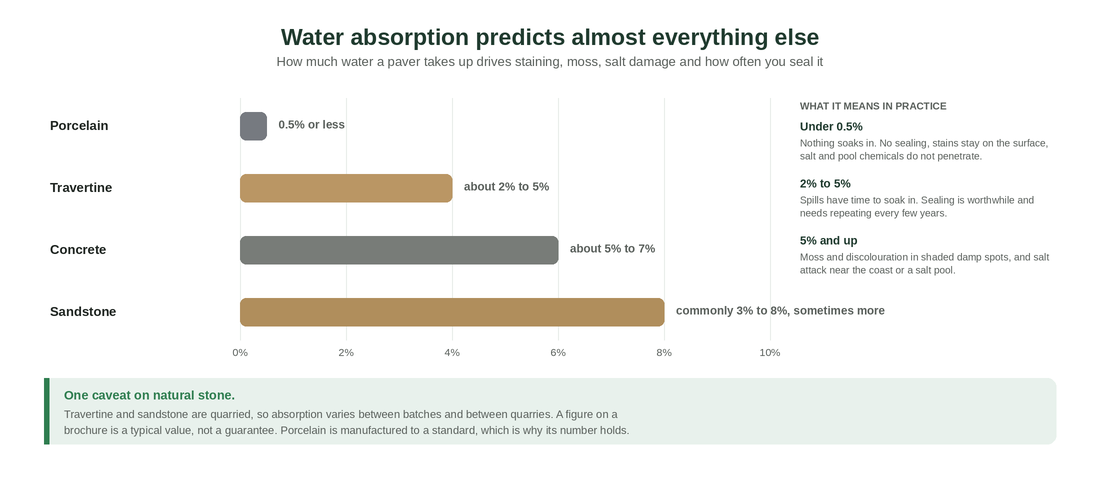
If you only take one specification from this guide, make it this one. A material that absorbs almost nothing cannot be stained from within, cannot grow anything inside its surface and is not vulnerable to salt crystallising in its pores. A material that absorbs 5 or 8 per cent can do all three, which is why it needs sealing and why the sealing has to be repeated.
One caveat on natural stone. Travertine and sandstone are quarried, so absorption varies between batches and between quarries. A figure on a brochure is a typical value rather than a guarantee. Porcelain is manufactured to a standard, which is why its number holds across a range.
| Material | Supplied and laid | What you are paying for |
|---|---|---|
| Concrete pavers | $65 to $150 per m² | Widest choice, driveway rated at 60 mm, lowest cost per m² |
| Travertine | $130 to $230 per m² | Cool underfoot, classic pool surround look, needs sealing |
| Sandstone | $130 to $280 per m² | Sydney character, weathers well, softest of the four |
| Porcelain | $120 to $260 per m² | No sealing, no fading, published slip rating, needs a correct bed |
Those rates generally cover the paver and the labour to lay it. Excavation, base preparation and, for porcelain, the concrete slab are usually separate lines. Our Sydney landscaping cost guide sets out how the rest of a paving project is priced.
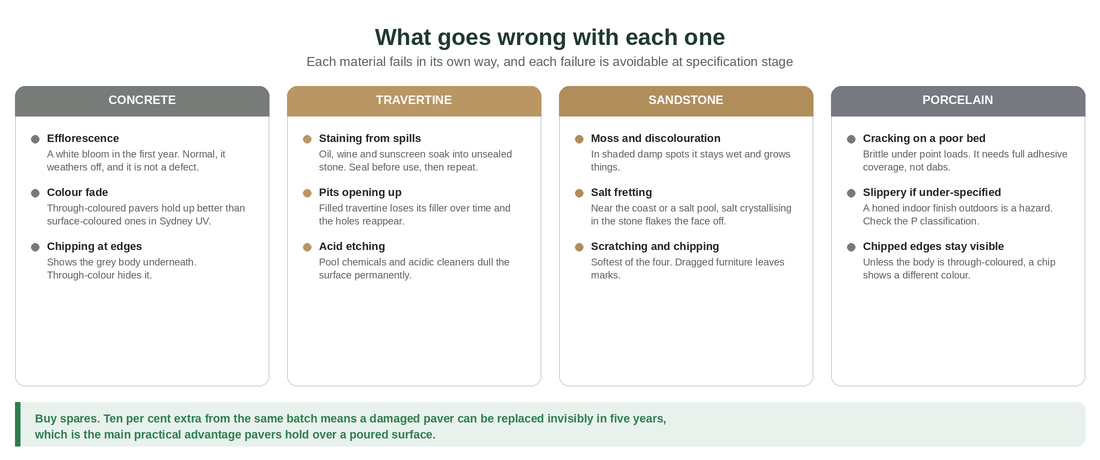
None of these are reasons to avoid a material. They are the questions to ask before ordering it.
Keeping any of them looking right is mostly about the right cleaner and the right sealing interval, which our guide to getting a longer life out of outdoor paving goes through in detail.
The material is roughly a third of a paving budget. The base underneath it and the labour to lay it are the rest, and both change depending on which of the four you choose. A porcelain quote with no slab in it, or a driveway quote with 40 mm pavers, is a quote for a surface that will not last.
Living Green Outdoors supplies and lays all four across South West Sydney as part of broader landscaping and paving work. Completed projects are on our portfolios page, and the suburbs we cover are listed on our service areas page. There is more on how paving sits within a wider scheme in soft versus hard landscaping and in our landscaping trends and ideas.
If drainage or permeability is part of the brief, that changes the shortlist again, and our guide to permeable paving covers the systems built for it. For a recommendation on your own site, get in touch and we will look at the aspect, the exposure and the base before suggesting a material.
The four used on most Australian residential jobs are concrete, travertine, sandstone and porcelain. Concrete pavers are manufactured from cement and aggregate and come in the widest range of shapes and finishes. Travertine is a form of limestone with characteristic pitting. Sandstone is a quarried sedimentary stone with a grainy texture. Porcelain is a fired ceramic made 20 mm thick for outdoor use. Clay and brick pavers, bluestone, granite and limestone are also used, with bluestone and granite common where hardness matters most.
Concrete, natural stone and porcelain. Concrete pavers are the most widely used because they are the cheapest per square metre and the only common option rated for driveways at 60 mm. Natural stone covers travertine, sandstone, bluestone, granite and limestone, each quarried with its own absorption and hardness. Porcelain is the fastest growing of the three, because it absorbs almost no water, needs no sealing and usually carries a published slip classification.
Concrete pavers in standard and large formats, clay and brick pavers, and natural stone including sandstone, travertine, bluestone, granite and limestone. Porcelain pavers at 20 mm thickness are now widely stocked, usually in 600 by 600 and 600 by 400 formats. Travertine is commonly sold in a French pattern set of four sizes. Concrete is made in both through-coloured and surface-coloured versions, and the difference matters for how it ages.
It depends on where they are going. Porcelain absorbs 0.5 per cent of water or less, never needs sealing, does not fade and usually carries a published slip classification, which makes it the stronger choice for pool surrounds, shaded damp areas and coastal sites. Concrete pavers cost less, are available in more shapes and sizes, can be laid flexibly on sand over roadbase, and at 60 mm are rated for driveways where 20 mm porcelain is not. Porcelain also needs a correct bed, usually a concrete slab or pedestals, which can add significant cost if one is not already there.
HB 198, the companion handbook to AS 4586, recommends a minimum of P4 together with a barefoot classification for pool surrounds, and P5 for ramps and stairs leading into the water. No Australian regulation makes a specific classification mandatory for a residential pool, but courts and insurers reference HB 198, which makes P4 the practical standard. Ask the supplier for the wet pendulum test report on the exact finish you are buying, because the same stone can test very differently sawn, honed or sandblasted.
No. A true porcelain absorbs 0.5 per cent of its weight in water or less, so liquids do not penetrate the body and there is nothing for a sealer to do. Stains sit on the surface and come off. That is the main difference from travertine and sandstone, which are porous and need sealing before use and periodically afterwards. Grout joints between porcelain pavers may still benefit from sealing, depending on the product used.
Not usually. 20 mm porcelain is a pedestrian product. Vehicle loads need either a thicker specialist product on a correctly engineered bonded bed, or a different material. The standard answer for a paved driveway in Sydney is a 60 mm concrete paver on a reinforced concrete base. If the look of porcelain matters, a practical compromise is porcelain for the patio and alfresco and concrete pavers for the driveway, chosen to sit together.
On hardness and water absorption, porcelain and granite lead, with porcelain at 0.5 per cent absorption or less and granite around 0.4 per cent. But durability outdoors depends more on the installation than the material. A 60 mm concrete paver on a properly compacted base will outlast a porcelain paver laid on dabs of adhesive over a cracked slab. Sandstone is the softest of the four common materials and the most prone to scratching, chipping and salt attack, though well-laid sandstone in a sheltered position lasts decades.
Your driveway, patio, or garden path is often the...
Robert EishoOctober 14, 2025Block Paving Trends for Beautiful Outdoor Spaces
Your driveway, patio, or garden path is often the first thing people see. Creating a beautiful outdoor space can completely transform the look and feel...
Robert EishoOctober 14, 2025Having a nice backyard is a dream for many...
Robert EishoApril 20, 2026Patio Paving Ideas to Upgrade Your Outdoor Space
Having a nice backyard is a dream for many homeowners. A great patio gives you a place to relax, entertain, and enjoy the fresh air. Upgrading this...
Robert EishoApril 20, 2026